Monday, June 21, 2010

Highlights of the Low Countries

June 15 - July 4: Belgium and the Netherlands

The stepped rooflines along Amsterdam's canals

Amsterdam's canal bridges


Andy, Sylvia, Aurora, and Naomi reunited with Sue and Ian - fun (and some sun)!


We had great fun meeting up with old Peterborough (now Hamilton and travelling) friends Andy and Sylvia and their two girls (NASA). We explored Brugge, Belgium, while tasting chocolate and then tasting more chocolate! We climbed the famous bellfry there with Naomi and made plans for our days together. Our goal was to reach Amsterdam in time for the Roots Music Festival. With all our gear loaded in the NASA 'sag wagon', we made our way north, still in cool weather and battling strong winds from the North Sea. We had strong headwinds and unseasonally cool/cold weather all 4 days through the western Zeeland islands to Amsterdam. We enjoyed large Indonesian food lunches, camping with Andy and Sylvia each night. The festival was great with an interesting Chinese folk band, East Indian rap group, and artists and food stalls, but the biggest cheers occurred for the sun when it shone! The weather started warming up just as Andy and Sylvia and the girls headed off to visit family in Germany.

Coming up the coast, we loved the towns of Middelburg, Delft and Leiden, and the canalside riding where boats of varying ages and character are parked in front of cute houses. We would have been more impressed with the dunes and dykes along the coast if it weren't for the wind. Best not to plan a bike route along a corridor of modern windmills - those engineers know where to place those things!

We have come 500 km in northern Belgium and Holland without a map, and we have only had to look around a bit for where to go, even in Amsterdam. How can that be, you ask? Throughout the country, yes, the whole country, each major intersection of a bike lane or separate bike path is assigned a number. Every 5 or 10 km, there is a map of the region, showing where all the numbers are. You plan your route by looking at the map, writing down the series of numbers that will get you to where you are heading, and following the directional signs with the numbers on them. Very simple - love it!

We love the numbering system for cycling routes, and we love the cycling facilities. In 500 km of unplanned routing, we have not been let down once! No highways without cycling trails on the side, no thoroughfares without cycling trails on the side, no roads without cycling lanes. Coming to a major international highway, it's easy: follow the cycling on-ramp up and around and take your segregated cycling trail across and down the other side. Or sometimes there are well-designed underpasses. And the routes through the countryside are almost all paved and with a constant flow of cyclists of all ages. We are in cycling heaven, for sure!

Watching the Dutch people cycle is interesting. For them, it seems to be meditative, like spinning. They pedal in a steady slow cadence, never slowing down, never braking. They look like they are going slowly on their upright city bikes, but even the old ladies are breezing past us. The wind knocks us back and they don't seem to notice it at all. If anyone tells you that cycling is so popular in Holland because it is a breeze, they mean it literally. Cycling is not easy here. Yes, it is flat, but the wind can be tough, really tough. Without our baggage, we were working hard on some days to break 12 km an hour. Our usually pace is 18-20 km/h on the flat. And if you think the French dress well, you haven't seen the Dutch on their bikes. We have seen some stunning outfits, including high heels and designer bike bags gliding past us. And the kids get a great ride perched up front or at the back on special seats, or commonly in a big front opentopped box. And the dogs love their trailers and handlebar baskets! Cycling is their meditation here; I think they need to do it like other cultures need to pray. I don't know if we can bike anywhere else now - we are so looked after as cyclists in Holland.

After our friends left for Germany, we spent three further days in Amsterdam at a great campsite and toured the city: the canal cruise at sunset was delightful, the houses and churches interesting, and the masterpieces and art history in the Rijksmuseum and Van Gogh Museum were impressive. We both enjoyed watching the cyclists and street scenes. We even tried out the colourful 'Heineken Experience', where we had fun (and of course beer) amidst all the history and marketing. We also took in a modern ballet, entitled 'Najinsky', that included powerful dancing. Both of our bikes got a tuneup at a local bike shop, with Sue´s getting new butterfly handlebars to ease her hand strain.

Then we were back on our (now fully loaded) bikes for a very pleasant ride east through a 10 year old town reclaimed from the sea, shady forests, heath, and easy trails for 115 km towards Arnhem. Unfortunately, Ian´s chain fell apart 12 km from town, so we left the bike at the train station´s secure bike parking with an arrangement for it to be repaired, and then made our way to a Peterborough friend´s sister´s house in southern Arnhem. Geert waited up late for us (she is a night owl, anyway) and was very hospitable. She showed us around the sand hills and heath vistas nearby and then explained the dike system along the Rhine at Nijmegen. She told us stories of what it was like for her family to live through the Second World War, giving us some better appreciation of what that era was like for so many in Europe.

We had made arrangements with Andy and Sylvia to meet again in De Hoge Veluwe National Park, just north of Arnhem. The park, the largest in Holland, was acquired in the early 20th century by a wealthy merchant family who purchased estates of ´wasteland´that had been overgrazed, deforested and become depleted heath and sand dunes. Mrs. Kruller-Muller also acquired a large art collection, including many Van Goghs and sculptures, and set up a museum within the grounds of the acquired lands. These were later turned over to a foundation and state to be managed as an integration of art and landscape, both nature inspired and human maintained. The availability of 1000 free white bikes made exploring the scenic forests, savannahs, heath and dune systems, plus the intriguing museum and sculpture garden, very accessible. Ian also got his repaired bike back, in much better shape!

We continued north through wonderful pastoral landscapes full of sheep, dairy cattle, and surprisingly many horses and ponies. Crops of corn and reeds for thatch, plus many baling systems, were evident along the way. We enjoyed watching several World Cup football/soccer games with the Dutch, who wear lots of orange and cheer with much enthusiasm! Forested parks with beech and oak tree lined avenues then made way for canals, lakes like the Kawarthas, and quaint villages such as Geithoorn. After too quick a tour of Assen, we were off by train to the bustling northern city of Groningen as we prepared for the next stage of our journey into Scandinavia.

Normandie and Northern France

May 29 - June 15:

Poppy season


Impressive family veggie plots
Honfleur, Normandy
Etretat, Normandy


Now we are in Normandie - home of soft cheeses (like Camembert), Percheron draft horses, hard and soft ciders, fish and Sue's ancestors. Ian was reminded often that if we saw something lovely, it was likely created by one of Sue's ancestors! The cycling is a little hillier in southern and northwest Normandie, with quaint houses splashed with rose trellises, daisies and irises. Like in the Loire, the window boxes add charm and colour to the streets.

We had a tail wind to the town of Vallieres where we stayed at a gite - a lovely cabin in the back yard of a house, complete with kitchen, fireplace and bed! The weather had turned quite nasty, so we were thankful for our cosy home for the night. A windy and challenging ride brought us to Canare, followed the next day by a splendid ride traversing a higher elevation protected forest affording broad vistas of the Normandie countryside, bringing us to the southern town of Mortagne.

We stayed at the Gros Chene (large oak) farm for 2 days, thoroughly enjoying participating in the table d'hotes. Table d'hotes is where we join the family hosts in a typical French meal. The meal was incredible with fresh bread and baudin noire (cold meat roll), local white asparagus in a rich cream sauce, fish, local soft cheeses like Camenbert and Livarot (cheese is served after dinner and before dessert here) and finally, fruit flan, all served with copious amounts of local hard cider with a splash of cassis. Local food specialties are core to the French culture and Normandie prides itself on fish, cream, hard and soft ciders and soft cheeses - we indulged ourselves accordingly!

We endured steep hills to reach the town of Talouvre and the museum featuring information about the people who emigrated from Normandie to settle old Quebec in the 1600's. Sue's father's family comes from this area in that era. The ride from Talouvre to Vimoutiere was heavenly, gliding through a small valley populated with horse farms, passing a handful of cars in hours, the last road being only 10' wide. The small D roads are heavenly in France. It is easy to get lost as signage is sparse at intersections, but when we can use these roads, it is a dream. Other times, a lovely cycling lane or trail can quickly disappear, launching us with no warning onto busier highways and thoroughfares. The further from the Loire that we travel, the more inconsistent the signage and cycling conditions seem to be. The campsites are all great and easy to find. Our camping neighbours are usually sociable 'caravaners' from England, Germany or Holland and other touring cyclists (more so in the Loire).

We reached the Atlantic Ocean/English Channel at Caen and met many friendly folks, including Stephan, an awesome bike mechanic who helped with bike adjustments. We participated in the D-day ceremonies on June 6 commemorating the start of the liberation of Europe. We were moved by how the war affected this area (and Allied families at home) and the warmth still extended to us as Canadians and cyclists. Many of the towns had streets and plazas named for Canada and the towns' liberation dates.

We had some highlights and lowlights along the next section of coast. We loved Trouville, Honfleur and St. Valery, but had a hellish ride through Le Havre, being dumped on a truck route from a dedicated cycling lane off the huge Normandie bridge. Apparently there was some sort of cycling trail 1-2 km after the bridge that no signage or tourism folks directed us to.

Heading north up the coast, we landed on a hilly campground at the ancestral home of Sue's family at Fecamp. The town is an intriguing mix of old and new, having a long history of boating and fishing, including early expeditions to the cod banks of Newfoundland. The local archivist dug out the baptism records of the two Marcotte brothers that emigrated to Canada from here, the ancestors of Sue's grandmother's family. We were quite surprised when the archivist pointed us to the 'rue des freres Marcottes', named after these same two brothers. We were even more impressed when exploring this 200 m section of road in the heart of town to find a house with a plaque commemorating the Marcotte 'pioneers to Canada'. After almost 400 years, a revolution, wars, etc., their memory lives on. And just around the corner from the street the city's ancient wall and the palace where William the Conqueror celebrated the conquest of Britiain in 1066!

Fecamp boasts 5 modern windmills on the top of the hill overlooking the town, alongside a windy campsite. Our riding from here on north was studded with windmills, all with their backs to us - i.e. headwinds for we poor cyclists!

The town of Etretats, just north of Fecamp, is stunning, with sculpted cliffs and limestone arches adorning both sides of the town. We visited the awesome Marquenterre bird sanctuary adjoining the Somme river estuary (storks, egrets, spoonbills, and lots of other waterbirds) and pounded our way north against continuing strong headwinds and increasingly cool and cloudy weather. We finally ran out of stunning white cliffs (up), flax and corn fields (flat), interspersed with cute coastal fishing villages (down) in Boulogne, where we hopped the train via picturesque Lilles to Brugge, Belgium. Here we met up with our great friends Andy, Sylvia, Aurora and Naomi from Hamilton, near the end of their own year of adventure that began in Asia.

We walked into an unknown train station, bikes in hand, and had a choice of several trains going our way all day - how awesome is that? We are grateful to be able to bring our loaded bikes on the trains, but a few ramps rather than stairs would be helpful! Once in Belgium, the train disembarking was MUCH easier! While the French have a deep love of cycle touring, and wished us 'bon courage' throughout our 1200 km of riding here, some of the details (and us, too) get lost along the way. We had to lift our bikes up and down flights of stairs and about 3' up onto and off the train.

In France, we felt so welcomed, both as cyclists and Canadians. Never once did we get a strange look from people that we would be cycling over hill and dale, along isolated country roads or along highways as needed. They appreciated and complimented our French, despite our language stumbles. The drivers, whether in minis or transports, are always respectful and gave us a safe wide berth. Our experience would have been improved if the signage and consistency of cycling facilities were better, but wow - thanks France for a real ride of discovery!

Tuesday, June 1, 2010

Paris et La Loire

May 9 - 28:

Putting the bikes together at Charles de Gaulle Airport

Eiffel Tower, Paris

Chombord, Loire Valley


Azay-le-Rideau Camping


Well, the European phase of our travels has begun! We landed in Paris and assembled our bikes at the airport (it took only 2 hours) before venturing into the Mont Martre district near downtown. We had arranged to stay with some fellow cyclists and enjoyed their company before shifting to a lovely youth hostel. During several days, we visited many of the highlights of the City of Light: the Eiffel Tower, Louvre, Luxembourg Gardens, Arc de Triomphe and Champs d'Elysses, Notre Dame Cathedral, Rodin and other museums, plus the ancient twisting streets and public spaces. We also used our own or rented bikes to go from place to place or along the Seine River; the bike public rental systems and paths are impressive. We enjoyed the ballet one night - choreographed by Nureyev - and a visit to the Fontainebleu forest and palace.

But we wanted to get cycling, and thus took the 1 hour journey by train to Versailles, site of a fabulous but overly extravagant palace and gardens. A great start to our camping, followed the next night by arrival in Chartres, home of the famous cathedral. A magnificent light show lit up the cathedral and other ancient sites in the city along a designated path. We then headed southwest to the Loire River valley and its famous chateaux (castles and gardens) of Chambord, Chenonceau, Blois, Azay-le-Rideau, and Villandry. Still, we also loved the ordinary small towns with their stone houses, old churches, and curving roads through the wheat and canola fields. We learned about the history of the common people in the Middle Ages as some lived in dwellings carved out of the limestone rock, once the stone for the chateaux had been removed - some people still live in such openings, or at least use them to store farm equipment and age their wine!

Yes, we have been enjoying French cheese and wine, and fresh croissants and pain au chocolat (or raisins) ordered the night before at the campsites. The bike trails and mostly quiet roads have made for good travelling, between 45 and 80 km per day, but the winds from the south and west have been strong at times, slowing us down a few days. Our cycling muscles are starting to tune up as our bodies adjust to our road routines and camping beds, but our butts and hands still get sore near the end of the day as we work out some kinks.

We are now pushing north past Le Mans into Normandy (Normandie) and look forward to the English Channel coast (called Le Manche in France).

Sunday, April 4, 2010

Floatin´ and Boatin´


March 31 - April 2:

From Cusco in Peru, we set off in a tourist bus southeast to Puno so we could see two archeological ruins along the way and a church with distinctive frescoes from the 1600s. The Raqchi site had over 120 ancient silos, used in Inca times for storing food to ensure food security in the dry season and in years of drought. Again, we were amazed by the Incan ingenuity and blending of their cultures with those that came before and after.

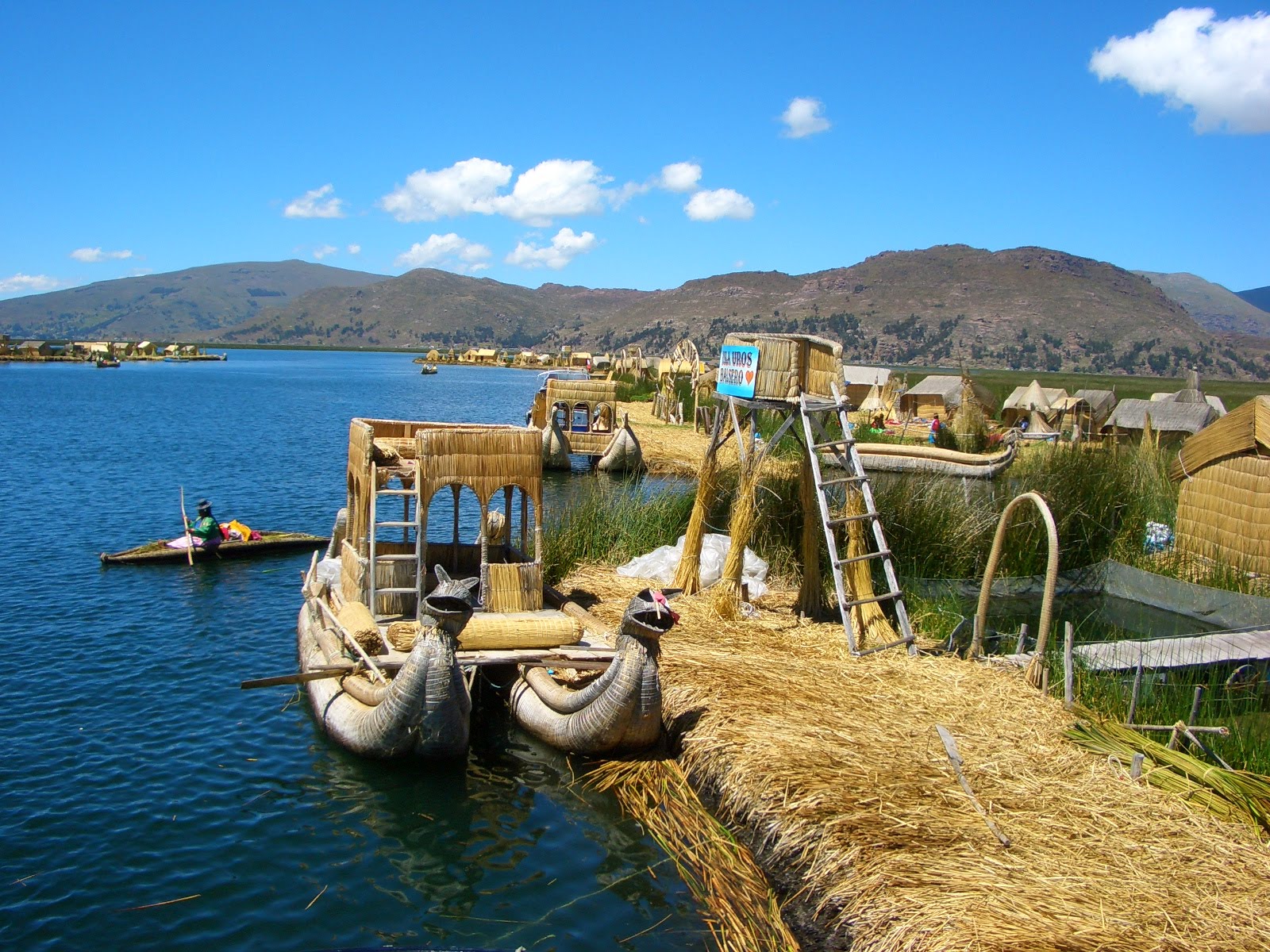
To see the sites on Lake Titicaca (the world´s highest navigable lake), we took a two day tour. The first place we stopped was the Uros Islands, famous because they are floating islands of totora reeds made by a distinct indigenous people. It was fascinating to see how they made their islands, homes and boats from the totora reeds (like Canadian bullrushes) found in the lake in that area. We noticed that many of their simple homes sported small solar panels, our first glimpse of renewable energy in use on our trip. Our next stop was Isla Amantani, where we stayed with an indigenous family that is paid like a small hostal for meals and lodgings. We found out afterwards that the tour company pays them only 10 soles of the 90 soles tour cost. There is no hostal or restaurant on the island, where a utopian socialism has created a splendid (and refreshingly quiet) community. We hiked up to the Patchepapa hill where there is a temple and views of the lake in all directions. We enjoyed the white mountain peaks of Peru and Bolivia´s Cordillera Real on the other side of the lake, fabulous views of the Amantani´s rock terraces of mixed crops, a scattering of other islands lit up at sunset, and later southern stars bright without light pollution. Dressed up in local outfits, we joined a local fiesta and danced with the elder women and our hosts´ young girls to traditional music. The next day, we walked the stone trail of Isla Taquiele, enjoyed a fish lunch and browsed the craft market. The weaving of Isla Taquiele has international recognition.

Back in Puno, we were intrigued by a meandering Good Friday street procession and prepared for our long bus trek back to Lima. We travelled via Arequipa in the southwest and then Pisco on the coast, where we discovered that Pisco (the white brandy from Peru) is from Ica and caught a glimpse of the national park there, Paracas. The area is mostly barren desert, sculpted by winds and crossed occasionally by mountain rivers that green up narrow valleys and crops.

In Lima, we were impressed with the private Museo Rafael Larco Herrera, with a fabulous collection of pottery, tapestries, paintings and gold and silver objccts from pre- and post-Conquest Peru (including displays of ancient erotica)! We read about a recent protest in Puerto Maldonado and managed to avoid the protests in Lima, starting up over the crack down on informal mining throughout the country. We witnessed small scale informal gold mining along the Rio Madre de Dios in the Amazon and were concerned about the contamination of the river system from the mercury used in the process. Hopefully our jaguars will be OK as the Heath River is better protected and upstream.
We are now excited to return to Canada as we wrap up our 3 months in Ecuador and Peru. It has been an intriguing adventure so far, with many highlights and delightful new friends, mixed with a few challenges along the way. Yet we miss family, our dog Rex, dear friends and the awakening of the earth as spring arrives in Peterborough. With Pisco (and Maracuyo) Sours and local beers, we salute and offer Mucho Gracias to Ecuador and Peru for their hospitality, history, diversity and amazing experiences along the way!

Tuesday, March 30, 2010

Jungle, Jags and Jhendy

March 25-30:


We spent 5 days in the Amazon and are now quite sure of the meaning of the word amazing! Our tour was through Inka Natura and we were lucky to have Jhendy Manzillo as our guide. We flew from Cusco to Puerto Maldonado, transferred to a long motorized canoe-shaped boat and headed down the Rio Madre de Dios, then up the Heath River to the Heath River Wildlife Centre. The lodge is slightly inside the Bolivian border adjacent to two large, unmanaged national parks. Along the river, we saw many turtles and several capybras (just picture a 200 pound guinea pig), and a toucan perched on an easily viewed branch at the Centre as we arrived ...

Luckily, the lodge generator had broken earlier that day, so we enjoyed our delicious dinner by candlelight in the largely open-air, screened dining area. We had our own lovely cabin at the Heath River Wildlife Centre, also lit with candles. After dinner on our first night, Ian headed out with our group and guide to a mammal lick where they saw a night monkey, tarantula and frogs. However, the tapirs were elusive, likely due to the large moon making it riskier for them to come out.

On our first morning, we rose at 5 am and were in the blind at the upriver macaw clay lick by 6 am. We stayed, mesmerized, until almost 10:30. Different species came in at different times, with the respendent red and green macaws providing the finale with over 50 congregating on the lick and trees in front of us at once. Birds, mammals and other critters come to special clay deposits to eat the clay in order to help detoxify the chemicals found in their vegetable diets. We then went for a walk in the selva (woods), a primary forest, with some interesting smaller trees and huge canopy trees, including the sacred ceiba tree, which people come to hug if they are sad. To wrap arms around the tree, you would likely need about 20 people, so it´s an open arm hug!

The second morning, we walked to the new tower being constructed for entering the canopy, 30 metres in the air. We didn´t see much there (except a few jaguar tracks), but the tower will be great for spotting monkeys, macaws and other birds. We then took the boat downstream to the nearby native village where we learned about their community and lifestyle (complete with a solar panel), and bought a small tapestry made from weaving the bark fibres of a rainforest tree. On the way there, the group was thrilled to have a rare, but brief, view of a jaguar. Sue was disappointed to have missed seeing it. On the way back to the lodge from the village, we were rewarded with the viewing of another jaguar close to where the first one was spotted. This time, we were awestruck. The young jaguar was not afraid of the boat and we had a full 7 minutes to stare and soak in the sight of a wild jaguar some 15 metres away, stretching, lounging, and rambling about. Being in the boat, we felt safe, which is a real bonus when jaguar watching! Folks at the lodge were very excited and they will use the photos of the jaguar´s facial patterns to identify and track the cat in future research.

Later that same day, we heard howler monkeys again (their eerie territorial call is frequently heard from the lodge) and then were lucky enough to see them quite close up, high in the trees.

Day 3 brought us to an oxbow lake a 10 minute walk in from the river. We saw interesting birds and black caimans there, with eyes that reflect a freakily bright red back from flashlights. White caimans were also discovered on the river. The big moon made another visit to the mammal lick a no go.
On day 4, we left the lodge at 4:30 am, heading for Sandoval Lake Lodge for us and to Puerto Maldonado for the others in our group. Ian saw a tapir on a beach in the dusky morning light. We hiked the very muddy 3 km into Sandovol Lake, famous for its endangered great river otters. Our luck stayed with us as we were practically greeted and circled by the otters as we were paddled onto the lake. We watched the family of 6 otters catching fish, some of which were pretty darn big! After lunch, we climbed the lookout tower on the lake and found ourselves face-to-face with brown cappuchin monkeys and enjoyed a spectacular sunset.

Staying at this upscale lodge was unfamiliar territory for us. What happened to the addage, paddle your own canoe...? Sue never minds being cooked for, but we would prefer to carry our own gear and paddle our own canoe (both of which our guides did for us)!

On day 5, we explored the lake again before heading back out the muddy (VERY muddy) trail en route to the airport in Puerto Maldonado. We saw 4 kinds of herons (including one with irridescent colours), more monkeys and many macaws flying overhead, including many red-fronted macaws at a wood lick.

Viewing so many animals in the Amazon in one trip is quite unusual. There is a lot of vegetation , and animals and birds are dispersed thinly through the forest. Our guide had only seen one jaguar before our trip. Perhaps seeing such highlights of what the Amazon holds within was a gift for all the environmental work we have done over the years. We have more hope for the Amazon than we did when we visited it in Ecuador, although we now understand better how fragile an ecosystem it is, despite its biodiverisity. From the air, we could see the patterns of small-scale gold mining (with mercury poisoning downstream) and the growing accumulation of small clearings around rivers and jungle roads. It is a tough place to survive, human or not, because the edible food supply is very low and hard to catch. Many of the plants and fruits are toxic, an adaptation developed for self-protection. However, some are great to eat, as we discovered at the lodges and in the Puerto Maldonado market. Thank you Amazon for a great experience!

Thursday, March 25, 2010

Cusco and the Incomparable Incas

March 18-25:


Cusco is the fabled ancient capital of the Inca people, which once supported the largest empire in the world, stretching from southern Colombia to Chile. We arrived in Cusco just in time for the Don Bosco ceremonies marking the Italian priest´s legacy of supporting health care and education for poor and rural people. The festivities were somewhat a transformation of Cusco history - the dramatic entry and pronouncements of the Inca ruler and musicians in the Quichua language, meeting with the Archbishop and Bosco representative, convergence of dancing school groups, parade of Don Bosco´s simulated body in repose, and then testimony to the good works over the last century-- all in front of the grand Cathedral on the central square with thousands gathered to watch. No conquistadors nor massacres, fortunately enough. The city and surrounding Sacred Valley are rightly proud of their Inca heritage, quickly overun to great loss by the Spanish conquistadors in the early 1530s. Today, the rust-coloured rooftops, arcaded squares, grand buildings and remarkable ruins of the area pay tribute to its history, survival and evolution.

We explored some of the city´s ornate churches, complete with gold, silver and carved wood artefacts plus Cusco School paintings that add Andean flavour to the period´s European Christian motifs. The hills and former Inca sites are now covered in Christian symbols and churches (a challenge to the multi-faith pluralism of we Unitarians). A 1950s earthquake topled part of one church to reveal the Incas´most sacred Temple of the Sun (Qorikancha), with incredibly fine masonry in their walls and reflecting a sophisticated astronomical and religious understanding. The Temple´s and other sites´gold and silver were looted by the conquistadores as the Inca ¨king´s ransom¨. Other remnants of Inca palaces remain in the city, again demonstrating a renowned masonry in the walls.


We spent one day exploring four nearby Inca ruins: the Sacsaywaman fortress-temple-observatory complex overlooking the city, with massive tiers of stone walls topped by the round temple that forms the eye in the puma design of the city; a massive rock carved into a temple; a hunting and administrative centre overlooking a valley; and a royal retreat and baths, with picturesque waterfalls flowing through Incan masonry. Another day we ventured further on an organized tour to the complexes at Pisac and Ollantaytambo (unfortunately, the tour did not stop at the prominent local markets, despite the itinerary). Both sites are perched high on mountain spurs overlooking the river valley and both contain incredible stone terracing, buildings, and observatories that catch the sun´s light at special times of the year. Again, we were impressed by Incan ingenuity and engineering, along with their and predecessors´agricultural adaptations (e.g. developing 1000 varieties of potatoes, and 50 varieties of corn and beans, all adapted to particular uses and elevations).


On our route, we also observed the remants of flooding and small landslides near the town of Pisac, which has suffered considerably this year during the rainy season and only now is starting to recover as the sun shines this week. The saturated soils and flooding of infrastructure has also closed the famed Machu Pichu since January, with rumours of reopening only part of the train route there next week (likely too late for us to visit). International tourism has fallen off in these last months, only partly replaced by visiting Peruvians supported by tourism incentives. Unfortunately, that has meant that we have borne our undue share of the on-street touting of tours, paintings, cigarettes, massages, and handicrafts at every step of the downtown core. Still, there are some fabulous weavings, metalworks and other artisan items on offer here, another legacy of Incan traditions.


It was Sue´s turn to be under the weather for a few days, due to altitude, pollution in narrow streets, and possibly from something she ate. Still, we have enjoyed great food here, in quaint restaurants overlooking the hubub of the central plaza - we even caught up with fellow travellers from Mississauga over a local specialty, the Pisco Sour. One evening we enjoyed an evening of folk dances as part of our expensive Tourist Ticket that allows widespread access to important sites. Overall, the city, Sacred Valley and their legacies are remarkable and we feel fortunate to have had the opportunity to learn and appreciate this historic and current centre of Incan culture.


Tuesday, March 23, 2010

Trekking the Cordillera Blanca

March 9-17:


The Pacific Coast beaches and sand were nice enough, but we longed for cooler climes and higher heights - the Cordillera Blanca of northcentral Peru. The Rio Santa Valley runs between the glacier-capped Cordillera Blanca and the nearly-as-high Cordillera Negra, with a string of Andean towns and the city of Huaraz. The bus trip from the coast at industrial Chimbote was spectacular as we climbed up through the Duck Canyon - twists, turns, the roaring Rio Santa below us, and high mountains and impossible zig-zag walking trails above us. We had to search around to get the day trip through the canyon, but it was worth it as glacier capped mountains were revealed as we got close to Yungay. This town was essentially wiped out in the 1970 earthquake and resulting landslide from Mt. Huascaran, the highest mountain in Peru (6768m). Only some 260 children survived the landslide, sheltered by a visiting circus. One of these children (now our age) was our taxi driver the next day, who took us to the magnificent Llanguanuco Lakes, green from glacial meltwaters flowing off the towering walls of the valley. Here we hiked for four hours, and combined rides with an athlete from the Czech Republic (who was much more ambitious than us!).


We headed to the valley´s central city of Huaraz and woke up the next day to a lovely array of white peaks surrounding us! The mornings started off bright but soon clouded in, often with rain in the mid-afternoon. We enjoyed some nice meals (delectable at Chef Cristof´s!), visited with folks from Belgium, and made arrangements for a 3-day trek into the mountains. Ian was sick for a day or so in town, but we started off in Olleros with fine weather and puzzled greetings from villagers along the way. Corn and other crops soon made way to potato cultivation and then sheep and cattle grazing, with stone corrals and seasonal thatched huts as we gained higher elevations. Besides the occasional herder, there were no people (but lots of cows!) as we climbed, encountering hail then cold, wind-whipped rain. At 3:30 pm we achieved our intended campsite (4000m), set up our rented tent, and quickly dove into our trusty, toasty sleeping bags. We had dried out and warmed up to eat our dinner, Chef Christof´s premade delicious pesto pasta. Early lights out at 7 pm, followed by an early sunny rise the next day. As we climbed, we had fantastic vistas back down the Rio Negro valley and up to glimmering peaks arounds us. We almost took a wrong turn to a southern glacier, but our good map led us onward in the right direction. At high altitudes, our abilities to climb were limited, with frequent stops on the uphills and a quicker pace on the flatter sections. We again encountered hail (which is fortunately not wet), and then reached the teasingly elusive Punta Yanashallash pass at 4700 m, complete with an old rock Inca tomba, or travellers´shelter. Glaciers, small ponds and craggy peaks surrounded us. On the downhill section, we strode along a wonderful stretch of a carefully constructed Inca road, paved and framed with carefully laid rocks - yes, used for half a millenia or more on this traditional route! We marvelled at the construction (beats the longevity of Canadian modern roads, for sure!) as well as the views of layered sediments heaved sideways and the pastoral valley below. The old trail was carpeted in grass, thoroughly nourished by cow dung and ample rivulets, for much of the way to our next campsite beside the river and near some occupied huts. The wind picked up significantly at dusk, and again we enjoyed our premade meals without the need to struggle with a camp stove. Sunshine greeted us at dawn, but our tin pot left outside had vanished - hopefully, to a good home where it will be well used. We had a lovely walk downhill through a winding valley above a deep gorge, sharing the well-built Inca trail occasionally with colourful local sheep and goat herders. We offered some of our leftover food to a gathering group of local kids, who have little education and a limited diet. Almost at the end of our trek, we were stopped by a municipal official who explained that there had been a landslide the day before that had eroded the next short stretch of trail, and that the town had equipment working on it and we would have to wait. Minutes later, he warned of a couple of blasts that ricocheted up the valley and tossed fist-sized rocks nearby amidst a widespread cloud of dust. At the ¨all clear¨ signal, we quickly scrambled across the improvised trail behind the official. At least we didn´t have to retrace our steps back over the pass! Another 3km or so and we arrived at the town of Chavin to find that the archaeological site was closed for the day, but that the hotsprings down the road were open all afternoon ... so after eating our lunch next to a town debate over one car slightly bumping into another, we headed to the hotsprings and soaked our trekking grime off in a private small pool! The cutest dog enticed us to share our chicken dinners with him (just like Rex would!) and we retired to a fine hotel overlooking the main square, complete with duvet covers and cable TV. The following day enabled us to explore the ruins of the 3000 year old Chavin de Huantar temple, the centrepiece of ancient Andean religious activities in Peru (we loved the sign at the edge of town - ¨Chavin: Established 1200 BC¨!). It is recognized as a UNESCO World Heritage Site for its open plazas, labyrinthian tunnels and chambers, temple, grand doorway, and intricate carbed stones and obeliscs. Impressive, even in the drizzle!

We missed the Chavin museum of artifacts since we needed to catch the bus back over another snow-dusted pass, past a gorgeous mountain-framed lake, to return to Huaraz and the rest of our luggage. A further night in town and then another winding bus trip out of the mountains and back to the desert of the coast. Entering Lima presented huge sand cliffs and surf, followed by the traffic, scattering of signs and intensity of urban Lima. We admired the colonial architecture downtown at dusk and found a hostel in an old colonial house across from (not in ...) the Convent of San Francisco. We adjusted to the change in altitude and landscape briefly before our morning flight from the colonial/current capital of Lima across the Andes southeast to the ancient Inca capital of Cusco.